 Sr-Nd-Hf-Pb isotopes : Neptune MC-ICP-MS
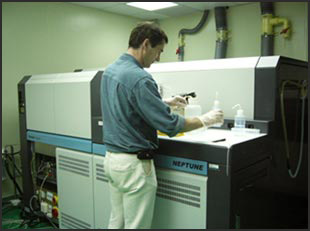

1 Sr, Nd, Pb and Hf isotopes on MC-ICPMS:
1.1 Sr isotopes:
The isotopic compositions of Sr samples have been analyzed for 2 years. Long-term reproducibility is ± 40 ppm (2σ) for 87Sr/86Sr determination in standard NBS987 (Fig. 1).

Fig. 1 Duplicate measurement of NBS987 Sr standard on NTU MC-ICPMS, Neptune. The long-term external precision is ± 40 ppm (2σ).
1.2 Nd isotopes:
Nd isotope measurement was started in June 2005. The principal Nd standard, JNdi-1 (Japan Geological Survey), has been measured over 200 times using different introduction devices and skimmer cones (H cone, or enhanced X cone). Two additional standards, the Rennes Ames Nd standard and the LaJolla solution, were also used. The long-term performance is ± 25 ppm (2σ) for 143Nd/144Nd in standard JNdi-1 (Fig. 2).
JNdi-1 standard results are presented below. Note that these measurement were done (except for the very first ones) during analytical sessions before and/or in-between measuring real rock samples. Accordingly, reproducibility of this standard is evaluated in real working conditions, including a trivial cross-contamination that always occurs in the introduction system.
An interesting observation of discrepancy of slightly different Nd isotopic composition measured using different introduction systems, the Standard Introduction System (SIS) and the Aridus membrane desolvation unit (Figs. 2,3).

Fig. 2 Duplicate measurements of JNdi-1 Nd standard on NTU MC-ICPMS, Neptune using the SIS. Our method gives a long-term external precision of ± 25 ppm (2σ; dashed lines).

Fig. 3 Duplicate measurements of JNdi-1 Nd standard on NTU MC-ICPMS, Neptune using the Aridus and either H or X cones. Our method gives a long-term external precision of ± 20 ppm (2σ). Data collected between November 2005 and November 2006 using two distinct Aridus units. Solid line indicates mean of measurements, dashed lines are +2σ and −2σ apart from the mean.
1.3 Pb isotopic determination on MC-ICPMS:
Lead isotopes have been used as geochemical tracers in Earth Sciences, such as geochemistry, paleoclimatology and chronology, due to the diverse ratios and variable elemental abundance. Determination of Pb isotope ratios, with 2-sigma external precisions of 100-150 ppm for 207Pb/206Pb and 208Pb/206Pb and 400 ppm for 204Pb/206Pb, can be performed with a Faraday cup protocol in static mode on a multi-collector ICP-MS (MC-ICPMS), Thermo Electron Neptune. A desolvation nebulization system, Cetac Aridus, and an X-skimmer cone were used to enhance signal intensity. With a sample uptake rate of 40-50 μL/min, Pb concentration of 5 ppb offers an ion beam intensity of larger than 1 volt for Pb. The sample size is as low as 3 ng of Pb consumed per measurement. Lead blanks, from acid, labware, and airborne particulate, was effectively reduced to less than 10 pg, which causes an isotopic ratio bias of 30-50 ppm at most.
Isobaric interference of 204Hg on 204Pb was corrected by monitoring the ion beam intensity of 202Hg. Mass dependant instrumental fractionation was normalized to 205Tl/203Tl value. If the sample is over-spiked with Tl/Pb ratio > 1, Tl tailing at 204Pb should be corrected (Fig. 4). A matrix effect of Ca concentration with Th-mass fractionation correction method (Fig. 5). The measured isotope ratios with 2-sigma external uncertainty of an international standard of NIST-Pb 981 are: 206Pb/204Pb = 16.9419 ± 0.0069, 207Pb/206Pb = 0.91481 ± 0.00007 and 208Pb/206Pb = 2.16752 ± 0.00031 (Fig. 6). The key merit of this technique is to provide a possibility of analyzing Pb isotopic composition in trace-quantity of 2 -15 ng, especially for sample with limited Pb content.

Fig. 4 Tl tailing effect on determination of 206Pb/204Pb and 207Pb/204Pb isotopic ratios for a Pb standard, NIST-Pb 981.

Fig. 5 Matrix effect of Ca concentration on Pb isotopic determination using Tl-mass fractionation correction method.

Fig. 6 Six-month reproducibility of NIST-Pb 981 isotopic measurements with 204Pb ion beam intensity of 30-100 mV using Tl-mass fractionation correction method.
1.4 Hf isotopes:
Hafnium isotopic standard has been measured on NTU Neptune sporadically in March-April 2004 and extensively in March and October 2006. Our main working standard is Ames Hf solution (Fig. 7). This standard is considered to be undistinguishable from the more commonly reported JMC 475 Hf. The hafnium standard was dissolved in a mixture of 3% HNO3 and 0.1% HF, the quartz cyclonic spray chamber cannot be used. Only the Aridus has been extensively tested up to now, using either the H nickel skimmer cones or the X nickel skimmer cones. The results demonstrate that a systematic shift in isotopic ratios is found between the two sets of cones. Care has been taken to ensure that all other parameters were kept as constant as possible to allow fair comparison between results. As the recommended or “best” value for 176Hf/177Hf value in JMC 475 standard solution ranges 0.282155-0.282170 (normalized to 179Hf/177Hf = 0.7325) for JMC 475 Hf standard using different MC-ICPMS models. The observation of discrepancy of 176Hf/177Hf values between H and X skimmer cores is still not fully understood (Fig. 8), which will further be addressed. Current method allows Hf isotopic ratio measurement on samples size smaller than 100 ng (typically 50-100 ng). Smaller samples of 20-30 ng can also be measured at the expense of internal precision.

Fig. 7 176Hf/177Hf ratios for Ames Hf standard measured on MC-ICPMS using the Aridus membrane desolvation unit with X or H cones. Gross average (pooling X and H results) gives 176Hf/177Hf = 0.282151 (2σ = 2×10⁻⁵). X cone results alone give average 176Hf/177Hf = 0.282144 (2σ = 6×10⁻⁶), and H cone results give 176Hf/177Hf = 0.282165 (2σ = 1×10⁻⁵).

Fig. 8 The systematic difference for 176H/177Hf on the same day using Aridus + X cone (runs # 1 to 5) and Aridus + H cone (runs # 6 to 10). For X cone average 176Hf/177Hf = 0.282143 (2σ = 1×10⁻⁶, n =5) for X cone. 176Hf/177Hf = 0.282159 (2σ = 3×10⁻⁶, n =5) for H cone.
